
 By
The short answer
For woods, single track, enduro and hard enduro, get full wrap-around handguards with aluminum bars: they protect your hands and levers best and survive drops. For motocross, track and easy trail, deflector-style guards are lighter, cheaper and enough. Before you buy, check your handlebar diameter (7/8″, 1″ or 1 1/8″ fat bar) and set your bars and levers first, then position the guards to clear them.
This post contains affiliate links. As an Amazon Associate I earn from qualifying purchases, at no extra cost to you.

Single track is the best riding there is right up to the moment your knuckles hit a tree. Worst case, you snap a lever or break a finger along with it. Handguards prevent most of that for very little money.
I think every trail bike should have some form of handguard. Here’s what they do, the two main types, how to choose and fit them, and the two sets I recommend.

What handguards do
Handguards are shields mounted on both ends of the handlebar, in front of the grips. They do five jobs:
- Stop flying debris and branches. Roost, gravel, mud, sticks and tree limbs hit the guard instead of your fingers. That matters most on muddy trails and when you ride close behind someone.
- Keep you warmer and drier. The guard forms an air pocket that diverts most of the rain, wind and cold, and keeps your gloves, grips and levers cleaner. Clean, dry grips mean better control.
- Save your levers. Levers usually break in one of two ways: you hit a tree or rock that pushes the lever into the bar (often pinching a finger), or you drop the bike. Good guards, especially wrap-arounds, cover both.
- Protect your hands in a crash. They divert the impact away from your hands and wrists. In a serious crash, metal guards are the ones you want.
- Help the bar slide off obstacles. A bare bar end tends to catch a tree and snap the bars sideways, which often means a crash. A guard pushes the bar off the tree and keeps it straight. Some wrap-arounds have a replaceable plastic slider to cut friction.

Wrap-around vs deflector handguards
| Wrap-around (bark busters) | Deflector style | |
|---|---|---|
| Best for | Woods, single track, enduro, hard enduro | Motocross, track, easy single track |
| Hand and lever protection | Best; very hard to break a lever when set up right | Medium; roost and branches, some lever protection |
| Durability | Aluminum bars can be bent back in a vise with some heat | Factory flaps and plastic mounts can break in a drop |
| Weight and cost | Heavier, higher initial cost, but last a long time | Light, cheap and easy to replace |
| Downside | Hand can slide inside on impact (wrist or finger injuries); can deflect abruptly off a tree | Can jam your fingers on impact |
Wrap-around handguards
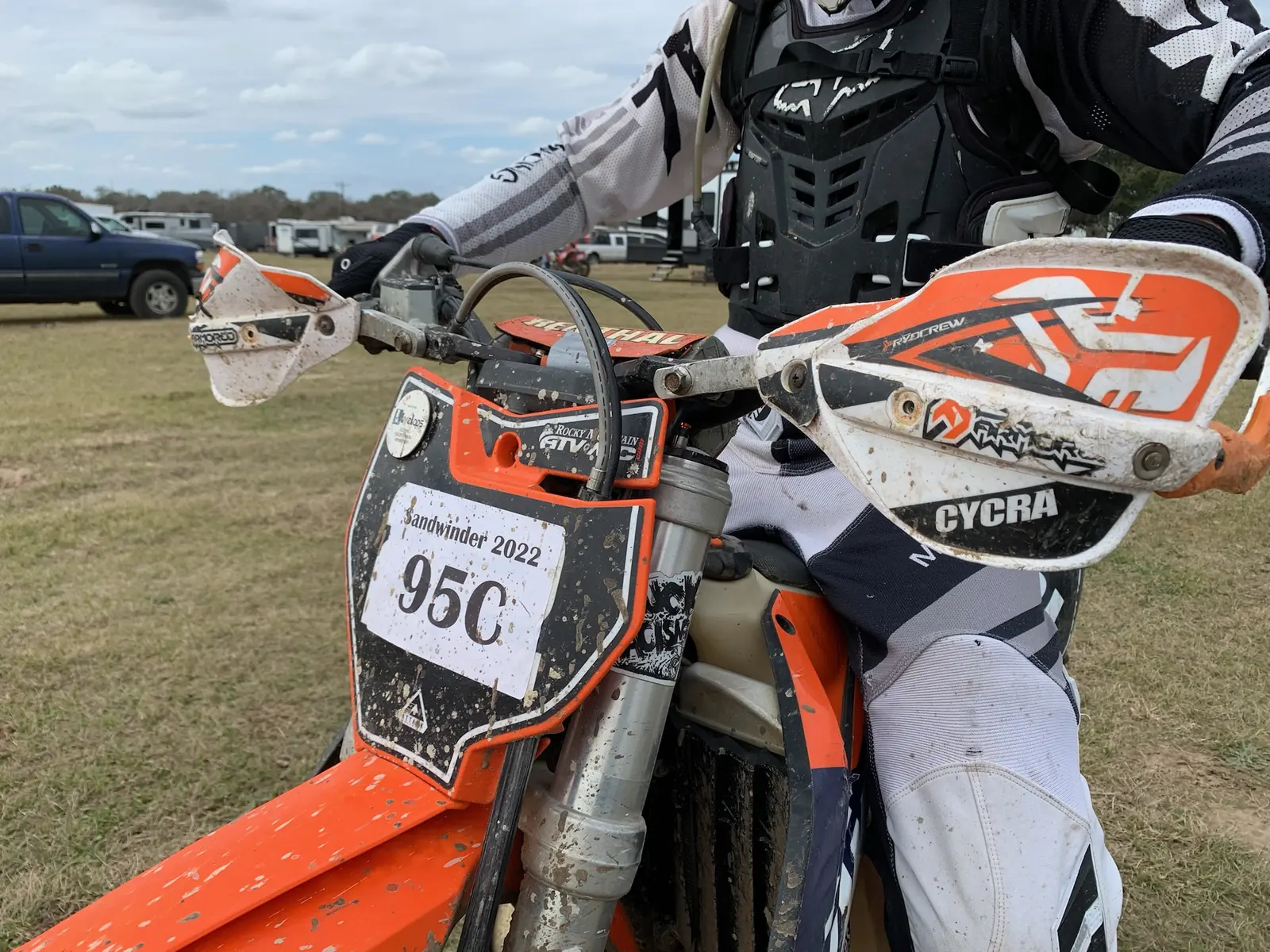
Full wrap-arounds are often called bark busters, after the marks riders leave hitting the same trees on the same trail. On tight single track you’re constantly hit by branches and roost, so many riders consider these the best enduro handguards. They adjust separately from your lever height and width, which gives you more control over the setup.
Some riders say wrap-arounds don’t give at all when you clip a tree and can throw you off line. In my experience, correct alignment minimizes that.
Deflector-style handguards

Many trail bikes come with flexible flap-style deflectors from the factory. They deflect roost, slide off trees well and are cheap to replace. The plastic housing that clamps to the clutch or brake perch is the weak point; it can snap in a drop. Some brands offer metal mounts or separate bar clamps, a middle ground between open deflectors and full wrap-arounds.

How to choose the right handguards
- Match them to your riding. Deflectors for motocross, track and easy single track; wrap-arounds for enduro, hard enduro, woods and technical single track.
- Decide what you’re protecting against. Weather and roost only? Deflectors do it. Direct hits and lever protection? Wrap-arounds. Just want to try handguards cheaply first? Start with deflectors.
- Check your handlebar diameter. Mounts are size-specific. Dirt bike bars are 7/8″, 1″ or 1 1/8″ (fat bar); most modern bikes use tapered fat bars. Measure just inside the grips and levers, where the mount clamps.
- Check positioning and clearance. Too high and the low side of the grip is exposed, so hits land on your fingertips. Too low and hits land on your wrist. Some designs won’t let you put the bars or levers where you want them, so check clearance before you buy.
Set up your handlebars and brake and clutch levers first, then fit the guards around them.
This section contains affiliate links. As an Amazon Associate I earn from qualifying purchases, at no extra cost to you.
My pick
Cycra Pro Bend Ultra Hand Guard Kit
Full wrap-arounds that are close to indestructible; you can buy every part separately and bend the aluminum bars back after a crash.
Budget pick
Enduro Engineering deflector handguards
Light composite deflectors that fit most bikes, install easily, are cheap to replace and work well in tight single track.
Beginner setup
Handguards are one of the first protection parts to add to a trail bike; the beginner hub lists the rest in order.
Related: dirt bike skid plates, 2-stroke pipe guards, disc brake guards and single track riding tips.
FAQ
What are the best dirt bike handguards?
For woods and enduro, full aluminum wrap-arounds such as the Cycra Pro Bend Ultra kit. For motocross and easy trail, lightweight deflectors such as Enduro Engineering’s are enough.
What are the best handguards for enduro?
Full wrap-around handguards (bark busters). They protect your hands and levers best on tight, tree-lined single track and survive drops; aluminum bars can be bent back if they get tweaked.
What parts stop damage from rocks on a dirt bike?
Handguards protect your hands and levers from roost and rocks. For the rest of the bike, look at a skid plate, radiator guards, a pipe guard and disc guards.
Do I need handguards on my dirt bike?
For trail riding, yes. Even simple deflectors keep roost, branches and weather off your hands, and wrap-arounds save levers and fingers when you drop the bike or hit a tree.
