
 By
The short answer
The best trail dirt bike for technical singletrack and enduro is the KTM 300 XC-W: a 293cc 2-stroke at 228 lb (103.4 kg) without fuel, with tunable low-end torque, a protected PDS rear shock and a wide-ratio gearbox. The Husqvarna TE 300 is a very close second, and the Sherco 300 SE Factory is third with the best suspension of the three. I ride a 2023 KTM 300 XC-W myself.
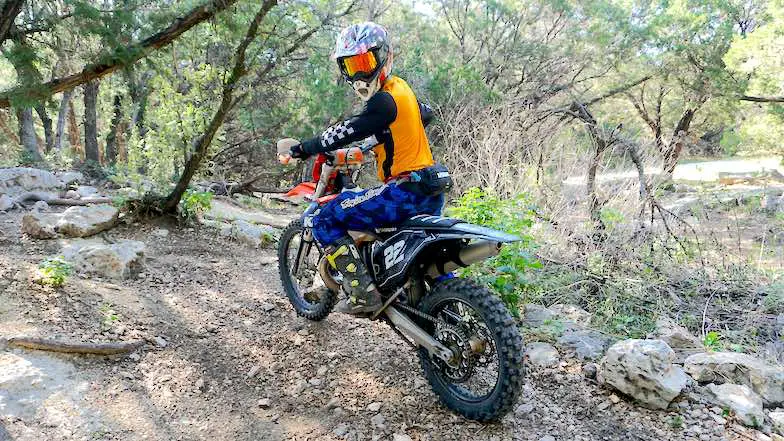
“Best trail bike” depends on the trail. Fast desert two-track and tight, rocky singletrack want different bikes. This guide is for the second kind: slow, technical trail and hard enduro, where traction and controllable power matter more than peak horsepower.
I have ridden and raced for 30 years and own my second KTM 300. I compared bikes built for trail riding (models labeled cross country, enduro, trail or off-road) on four criteria: engine type, engine size, sub-model chassis, and protection. Motocross bikes are not on the list, for reasons below.
If you are new to riding, start with my best beginner dirt bikes instead; for women riders, see best dirt bikes for women.
My top 3 trail dirt bikes
| Rank | Model | Engine | Seat height | Weight (no fuel) | Tires F / R | MSRP (when compared) |
|---|---|---|---|---|---|---|
| 1 | KTM 300 XC-W | 293.2cc 2-stroke | 37.8″ (960 mm) | 228 lb (103.4 kg) | 80/100-21 / 110/100-18 | $11,099 |
| 2 | Husqvarna TE 300 | 293.2cc 2-stroke | 37.4″ (950 mm) | 234.6 lb (106.4 kg) | 80/100-21 / 110/100-18 | $11,199 |
| 3 | Sherco 300 SE Factory | 293.14cc 2-stroke | 37.4″ (950 mm) | 228 lb (103.4 kg) | 80/100-21 / 110/100-18 | $11,849 |
All three are 300cc 2-stroke enduro bikes within a few pounds and a few hundred dollars of each other. Here is how I got there.
Engine type: why a 2-stroke wins on technical trail
Modern dirt bikes all make enough peak power. On technical trail I want maximum traction and power delivery I can control and tune, with strong low-end torque. That is what separates the engine types.
| Engine | Strengths | Weaknesses | Best for |
|---|---|---|---|
| 2-stroke | Lighter, tunable with the power valve, strong low-end on 250 to 300cc, little engine braking, runs cooler | Less engine braking changes clutch and brake technique | Tight singletrack, woods, hard enduro |
| 4-stroke | Lots of usable power at high rpm, gearing suited to covering distance | Easier to stall, less low-end, runs much hotter | Fast, open, desert, sand and sometimes mud |
| Electric | Flat torque across the range, no delay | Weight and range; no clutch or gears | Beginners and short technical loops |
The lack of a clutch and gears keeps electric bikes in the beginner category for me; the KTM Freeride E-XC made fourth on my beginner list. Watch the FIM Hard Enduro World Championship and you will see mostly 2-strokes, because they pack big low-end torque into a light, compact package. KTM and Husqvarna lead 2-stroke development, so my pick comes from them.

Engine size: 300cc, not smaller
Full-size 2-strokes for adults run from 150 to 300cc. Smaller engines are lighter and turn quicker, which is why many veteran woods riders like 250s such as the KTM 250 XC or XC-W and the Yamaha YZ250X.
Smaller is not easier, though. A small 2-stroke makes its power high in the rpm range, “on the pipe” with the power valve open. You have to rev it hard to get usable power, and that can loop the bike out on a technical climb. The 300 has massive, controllable low-end torque and peak power comparable to a 450cc 4-stroke.
- Technical trail and hard enduro: 300cc.
- Tight woods, lighter rider who likes to rev: 250cc.
- Second bike after a beginner bike: 200 or 250cc, with the power valve set so the hit comes high and soft. Not as a first bike.
On the rocky, tight trails I ride in Texas, the 300’s low-end torque lets me lug a gear higher instead of fanning the clutch.
Sub-model: enduro chassis, PDS shock, wide-ratio gearbox
Manufacturers sell separate enduro sub-models with different suspension, engine tuning and gearing. KTM is the clearest example:
- XC (cross country): linkage rear shock, its own triple clamps and fork setup.
- XC-W: PDS rear shock (no linkage), wide-ratio gearbox, softer enduro setup.
A linkage shock can perform better, but the linkage hangs low and is easier to damage in rocks and logs. The PDS shock sits higher and hidden, which gives more protection and clearance over big obstacles. For technical trail I want the PDS shock and the wide-ratio box. That points straight at the KTM XC-W series.
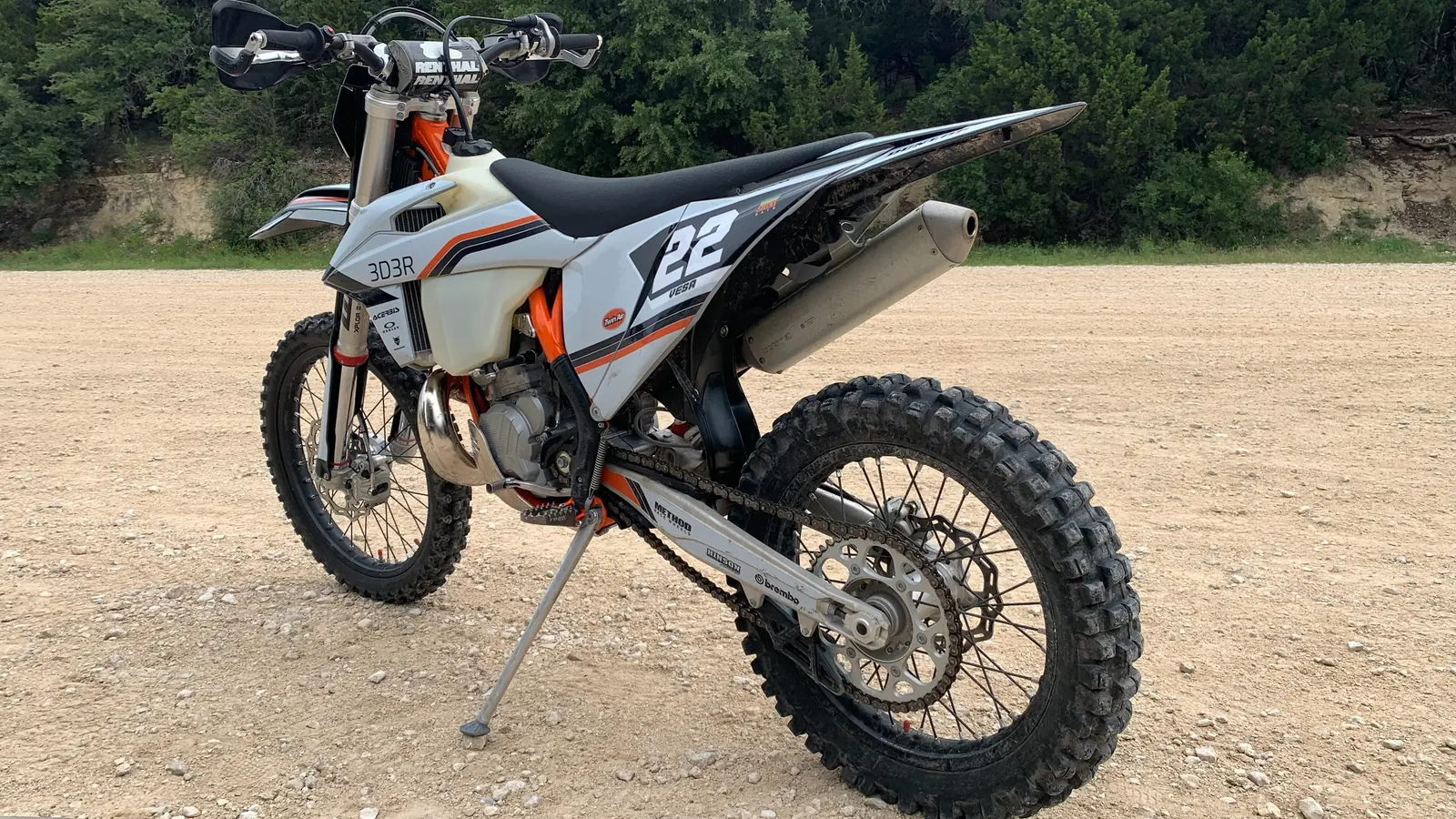
I don’t recommend motocross or supercross models for technical singletrack. Their suspension is far too stiff for trail and wears you out. Some advanced riders do run SX models for the engine and gearing, but they replace the suspension with trail-specific parts to make it work.
Winner: KTM 300 XC-W

It ticks every box: 300cc 2-stroke, PDS shock, wide-ratio gearbox, light chassis. It comes nearly race-ready and many pro hard enduro riders choose it. It still needs suspension tuned to your weight and pace, and it needs protection (skid plate, guards) for rocky trail. After that, there are few excuses left. It is also easy to find used, with a huge aftermarket.
The first thing I changed on mine was the suspension: Race Tech set it up for my 170 lb and racer pace. More detail in my KTM 300 XC-W trail test and the later model-year updates.
Runner-up: Husqvarna TE 300

KTM owns Husqvarna, and the TE 300 shares the same 293.2cc engine. It has slightly better components than the KTM. It lost first place for one reason: the linkage rear shock, which is more exposed on rocky trail. It is also 6.6 lb heavier and $100 more.
Third: Sherco 300 SE Factory

Sherco’s switch to a counterbalanced 2-stroke in 2021 made the SE 300 a real contender. Its strength is suspension: KYB components, which many riders rate above the WP XPLOR parts on the KTM and Husqvarna. I have ridden the 2020 and 2021 models and both felt excellent, but the 2020 and older bikes vibrate a lot without the counterbalancer. Buying used, get a 2021 or newer.
Buying used
A used KTM XC-W or XC from 2017 or newer is the best used trail bike. They typically sell for around $4,000 to $7,000 on Facebook Marketplace. Budget for a suspension service and protection on top.
The top three are close. If you can, ride all three at a manufacturer demo day or a dealer that offers test rides; small details like ergonomics and suspension feel will decide it.
Advanced setup
Once you have the right bike, the advanced path covers the suspension, power valve and protection setup that make it work on technical trail.
FAQ
What is the best enduro bike for beginners?
Not a 300 as a first bike. Start with one from my best beginner dirt bikes list, then step up to a 200 or 250cc 2-stroke enduro with the power valve set soft.
What is the best 250 trail bike?
The KTM 250 XC-W. The Yamaha YZ250X is the other 250 2-stroke many woods riders prefer.
Are 2-strokes better for trail riding?
Yes, for most trail riding. They are lighter, run cooler, tire you out less and their power is easier to control. 4-strokes are better on fast, open, desert or sandy trails.
Can you use a motocross bike for trail riding?
Yes, but you probably won’t like it. Motocross suspension is built for big jumps and high speed, so it feels harsh on trail and tires you out quickly.
What is the best used trail dirt bike?
A 2017 or newer KTM XC-W or XC. They typically sell for $4,000 to $7,000 on Facebook Marketplace.
