
 By
The short answer
Measure from the rear axle to a fixed point on the fender three times: bike on a stand, bike on its own, and you on it in full gear. On a full-size bike aim for about 30 mm (1.25″) free sag and about 110 mm (4.25″) rider sag. Turn the shock’s spring preload ring to get there. It takes about 30 minutes and a tape measure.
This post contains affiliate links. As an Amazon Associate I earn from qualifying purchases, at no extra cost to you.
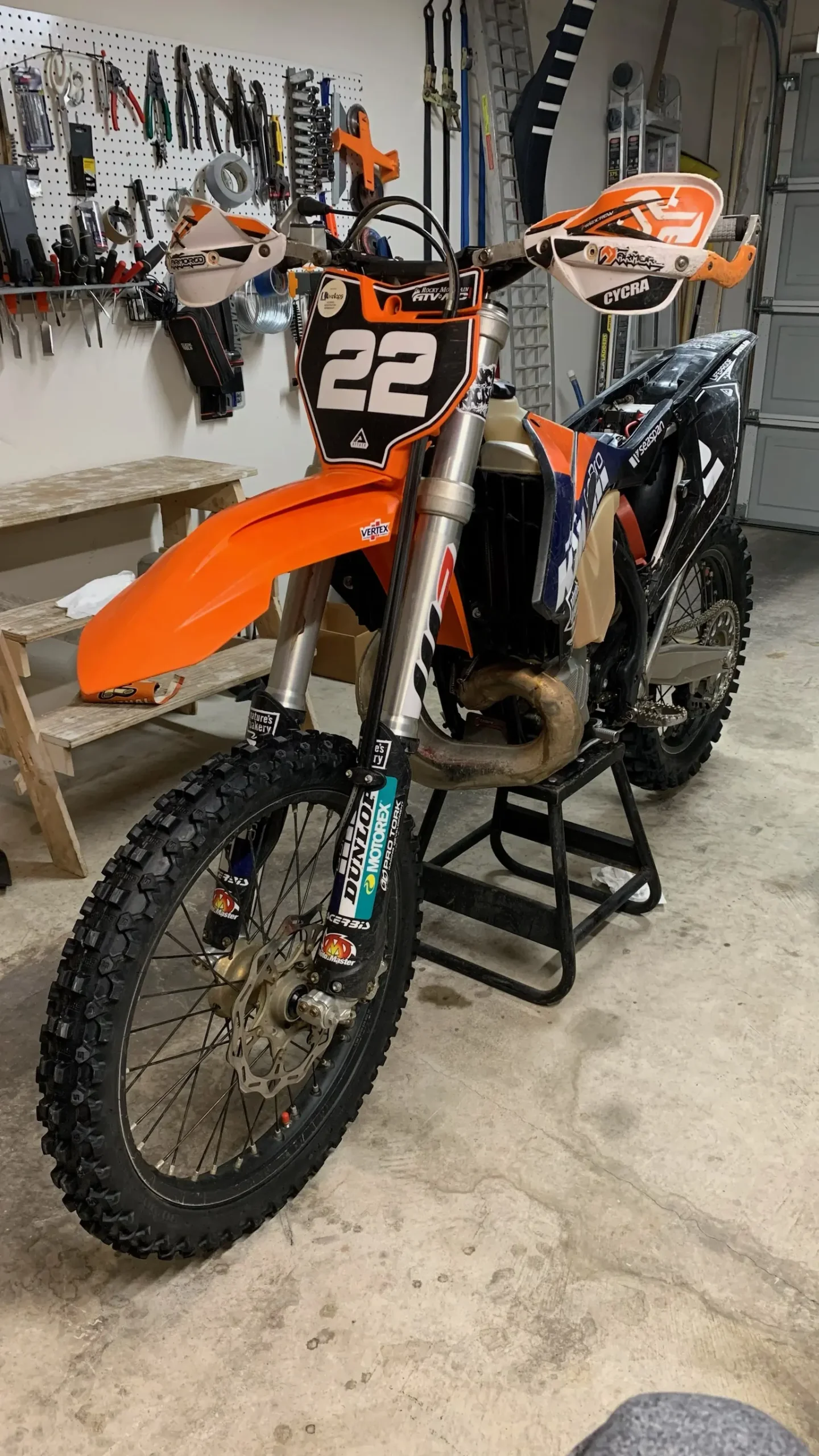
Sag should be the first thing you set on a newly bought dirt bike, before clickers, bars or anything else. Your total weight in riding gear decides how much preload the rear spring needs, and if it’s off, the whole bike is off balance.
If the rear bottoms out, feels harsh over obstacles or the bike feels unstable, check sag first. Below is the tape-measure method I use, a worked sag calculator, and the sag numbers I recommend for trail riding.

What is sag on a dirt bike?
Sag is how far the rear suspension compresses under the bike’s own weight and under your weight. You set it with the rear shock spring preload. Correct sag lets the shock work in the range it was designed for and balances the rear with the front suspension.
| Sag type | Also called | Measured | Target (full-size bike) |
|---|---|---|---|
| Free sag | Static sag | Bike on stand vs. bike standing on its own, no rider | About 30 mm (1.25″) |
| Rider sag | Total sag, race sag | Bike on stand vs. you on the pegs in full gear | About 110 mm (4.25″) |
Your service manual lists the exact numbers for your bike; use those if they differ.
Signs your sag is wrong
- Rear shock bottoming out
- Harsh hits over obstacles
- Bouncy rear or poor damping feel
- Instability at higher speeds
- Front and rear suspension feel unbalanced
- Rear sits noticeably lower or higher than the front
Tools
A tape measure, a pencil, a stand and a friend. You can usually turn the spring and preload ring by hand. A shock spanner wrench (sometimes sold as a sag tool) helps when the ring is stiff or stuck, especially on older bikes. Clean the threads before you start: the lock ring is usually plastic, and dirt in the threads causes trouble.
How to set sag on a dirt bike in 6 steps
Step 1: Check the spring rate

With the bike on a stand, rotate the spring until you find the stamped rate, then look up the rider weight range for that rate. Factory springs usually suit a rider of about 160 lb (75 kg) in gear. If your geared-up weight is well outside the spring’s range, get the right spring first; no preload setting will fix it.
Step 2: Measure free sag

- Put the bike on the stand with the rear wheel off the ground.
- Mark a measuring point on the rear fender with a pencil (or a small notch). I do this so every measurement uses the same spot.
- Measure from the rear axle (or the swingarm right at the axle) straight up to the mark. Write it down. This is your max distance.
- Take the bike off the stand, push down on the seat a few times and let it settle upright on its own.
- Measure again and write it down.
- Subtract the second number from the first. That’s your free sag. Aim for about 30 mm (1.25″).

Step 3: Measure rider sag

- Put on all your riding gear.
- Stand on the pegs, centered. Don’t sit or lean forward or back. I use the stand as a balance aid to hold the bike upright.
- Bounce on the pegs a few times and let the bike settle.
- Have your friend measure from the axle to the fender mark.
- Subtract this from the max distance in step 2. That’s your rider sag. Aim for about 110 mm (4.25″).
Dirt bike sag calculator
| Sag type | Max distance (on stand) | Measured distance | Sag |
|---|---|---|---|
| Free / static sag | 25 1/4″ | 23 15/16″ | 1 5/16″ (1.31″, 33 mm) |
| Rider / total sag | 25 1/4″ | 21″ | 4 1/4″ (4.25″, 108 mm) |
Sag = max distance minus measured distance. If both numbers land in range, you’re done. If not, adjust the preload.
Step 4: Loosen the spring lock ring

Put the bike back on the stand with the rear tire fully off the ground. Loosen the lock ring at the top of the spring.
Step 5: Turn the preload to adjust sag
| Rider sag is… | Do this |
|---|---|
| Too much (over about 110 mm / 4.25″) | Add preload: turn the spring tighter, usually clockwise seen from the top |
| Too little | Remove preload: turn the spring looser |
- Hold the spring and the preload ring together and rotate them as one.
- Re-measure both free and rider sag after every change. Preload moves both numbers at once; that’s normal.
- Repeat until both are in range.
If you can’t get both numbers in range at the same time, the spring rate is usually wrong for your weight. Sticking shock bushings or swingarm bearings can cause the same problem.
Step 6: Lock it and write it down
Tighten the lock ring. Write down your final free and rider sag. Old numbers make troubleshooting and fine-tuning for different trails much faster.
Dirt bike sag for trail riding
The recommended sag is a good setting for most trail riding. From there, fine-tune for the terrain:
| Trail type | Rider sag | Also adjust |
|---|---|---|
| Very technical trail | Slightly less: about 105 mm (about 4″) | Match rebound clickers to the feedback |
| General trail riding | Recommended: about 110 mm (4.25″) | Nothing |
| Faster, flowy single track | Recommended, or slightly more: about 115 mm (4.5″) | Add a few compression clicks to stop bottoming |
Less sag (more preload) keeps the rear slightly higher, which helps when you hit obstacles at speed. More sag softens the ride on flowing trail, which is why you add compression to keep it off the bump stop.
What I use
Shock spanner wrench
Turns a stiff or stuck preload ring without chewing up the plastic lock ring.
Read next: dirt bike suspension setup, dirt bike handlebar position and best dirt bike tires for trail riding.
Beginner setup
Sag comes first in any setup, and my beginner hub lists the steps that build on it.
FAQ
How do you set sag on a dirt bike?
Measure from the rear axle to a fender mark with the bike on a stand, on its own, and with you on it in full gear. Then turn the shock spring preload until free sag is about 30 mm (1.25″) and rider sag about 110 mm (4.25″).
What is the best dirt bike sag for trail riding?
About 110 mm (4.25″) rider sag. Go to about 105 mm (4″) for very technical trail and up to about 115 mm (4.5″) for fast, flowy single track.
How do you calculate dirt bike sag?
Subtract the loaded measurement from the max distance on the stand. Example: 25 1/4″ on the stand minus 21″ with the rider on gives 4 1/4″ (108 mm) rider sag.
What is static sag on a dirt bike?
Static (free) sag is how far the rear drops under the bike’s own weight, with no rider. On a full-size bike it’s about 30 mm (1.25″).
What is race sag?
Race sag is another name for rider or total sag: how far the rear drops with you on the pegs in full gear. Aim for about 110 mm (4.25″) on a full-size bike.
