
 By
The short answer
Size a kid’s dirt bike by height, not age: sitting on the bike, the balls of both feet should touch the ground. As a rule of thumb, 3–4-year-olds start on a 13–17″ (33–43 cm) electric balance bike like the Stacyc 12eDrive, 5–8-year-olds ride an 18–26″ (46–66 cm) seat (Yamaha PW50, TT-R50E, Honda CRF50F or an Oset), 9–10-year-olds move to a 110cc automatic such as the Yamaha TT-R110E (26.4″ / 67 cm), and 11–12-year-olds fit a 26–31″ (66–79 cm) seat like the Kawasaki KLX110R or Honda CRF125F.
This post contains affiliate links. As an Amazon Associate I earn from qualifying purchases, at no extra cost to you.
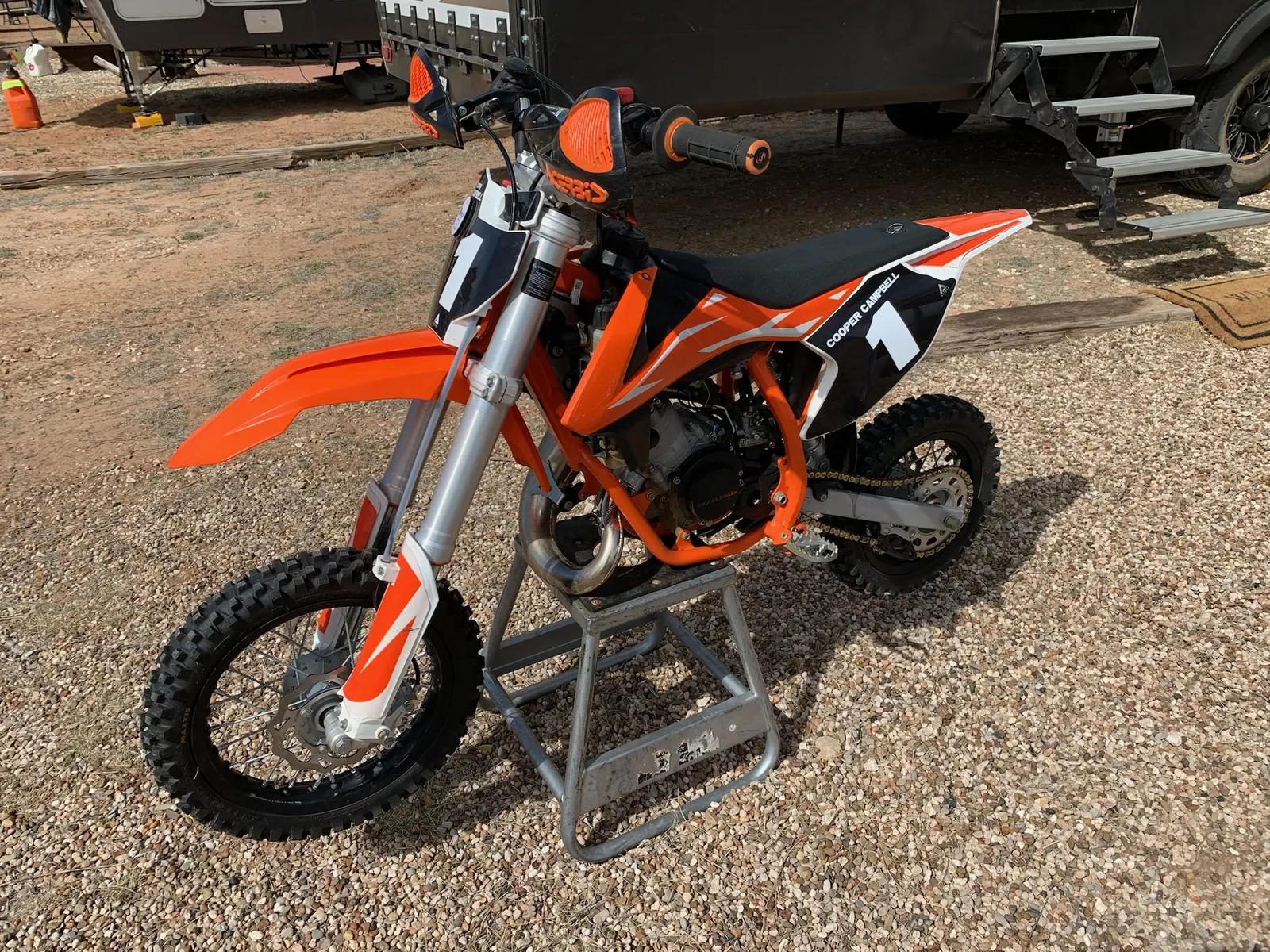
Two 8-year-olds can be a head apart in height and years apart in riding experience. That’s why “a dirt bike for an 8-year-old” is the wrong question. Height decides the seat, experience decides the power, and the kid’s confidence decides when to step up.
I’ve ridden and raced on and off for 30 years. This page puts all my kids’ bike picks in one place: a size chart by age and height, the bikes I’d look at for each age band from 3 to 12, when training wheels make sense, and what to look for before you buy. Every model keeps its seat height, weight and price at the time of writing.
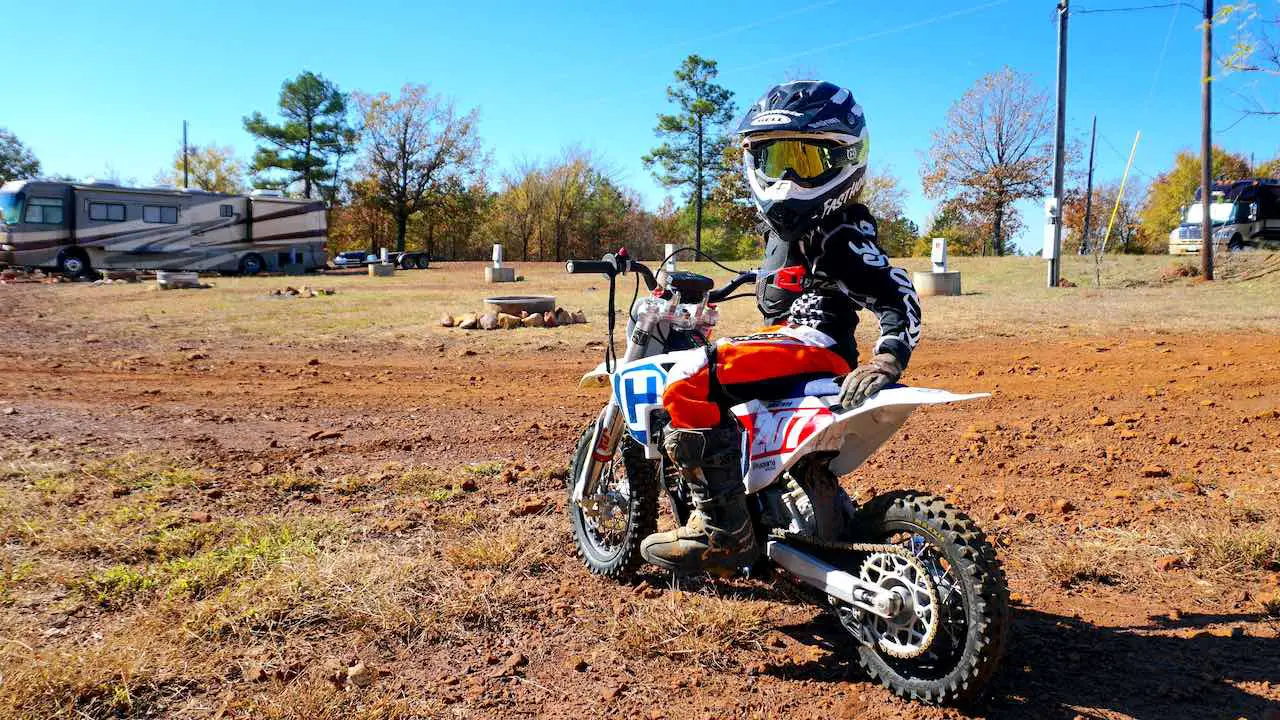
Kids’ dirt bike size chart by age and height
| Age | Typical height | Seat height to look for | Typical power | Start with |
|---|---|---|---|---|
| 3–4 | 2’10″–3’7″ (87–110 cm) | 13–17″ (33–43 cm) | Electric balance bike | Stacyc 12eDrive, Oset 12.5 |
| 5–6 | 3’2″–4’1″ (97–125 cm) | 17–24″ (43–61 cm) | Electric, 50cc automatic | Stacyc 16eDrive, Oset 16.0, Yamaha PW50 |
| 7–8 | 3’6″–4’6″ (108–137 cm) | 18–26″ (46–66 cm) | Electric, 50cc, 65cc | Yamaha TT-R50E, Honda CRF50F, KTM SX-E 5 |
| 9–10 | 3’11″–4’11” (119–150 cm) | 24–27″ (61–69 cm) | 110cc automatic, mid-size electric | Yamaha TT-R110E, Honda CRF110F |
| 11–12 | 4’3″–5’4″ (129–162 cm) | 26–31″ (66–79 cm) | 110–125cc, 85cc for racers | Kawasaki KLX110R, Honda CRF125F |
Average heights help you narrow the list: about 37″ (94 cm) at 3, 40″ (102 cm) at 4, 43″ (109 cm) at 5, 45″ (114 cm) at 6, 48″ (122 cm) at 7, 4’2″ (128 cm) at 8, 4’5″ (134 cm) at 9, 4’6″ (139 cm) at 10 and 4’8″ (144 cm) at 11. A 9-year-old’s inseam is typically 21–24″ (53–61 cm).
How to check the fit
- Sit the kid on the bike with the bike upright.
- Only the balls of both feet should touch the ground. That’s tall enough to leave room to grow, low enough that they aren’t scared of tipping over.
- If both feet are flat, the bike is already too small and will need replacing within a year.
- Pick the largest wheels available at that seat height. Bigger wheels are more stable in loose rock, sand and ruts.
Teach the kid this check at home before you visit a dealer. Left alone, most kids pick a bike that’s too short because it feels less intimidating. For older kids and bigger bikes, use my full dirt bike size chart, and once they pass about 4’8″ (142 cm), move on to dirt bikes for teens.
Ages 3–4: electric balance bikes
Most kids start on an electric balance bike. No clutch, no gears, no kick starting, very little maintenance, and almost no noise. Turn it on and ride. A good sign the kid is ready: they’re confident and balanced on a bicycle.
Stacyc makes the best-known ones, and the KTM, Husqvarna and GasGas versions are built by Stacyc. They’re the same bike in different colors and stickers, so buy whichever is cheapest or easiest to find used. Stacyc bikes hold up well second-hand.
| Model | Ages | Seat height | Weight | Speed modes | Battery | Price |
|---|---|---|---|---|---|---|
| Stacyc 12eDrive (KTM SX-E 1.12, Husqvarna EE 1.12, GasGas MC-E 1.12) | 3–5 | 13″ (33 cm) | 17 lb (7.7 kg) | 5 / 7 / 9 mph | 2Ah, quick-change | $799–829 |
| Stacyc 16eDrive (KTM SX-E 1.16, Husqvarna EE 1.16, GasGas MC-E 1.16) | 4–8 (Stacyc says 5–7) | 17″ (43 cm) | 20 lb (9 kg) | 5 / 7.5 / 13 mph | 4Ah, quick-change | $914–1,069 |
Brand versions on Amazon: KTM 12eDrive, KTM 16eDrive, Husqvarna 12eDrive, Husqvarna 16eDrive, GasGas 12eDrive and GasGas 16eDrive.

If you’d rather start on a small electric dirt bike, the Oset 12.5 Racing is the one: a 15″ (39 cm) seat, trials-style riding position, 12.5″ wheels and very controllable power. It’s built for 3–5-year-olds with no riding experience, up to 60 lb (27.3 kg). It has a 600W 24V motor and two 10Ah AGM batteries, weighs 58 lb (26.4 kg), and cost $1,699–1,899 at time of writing.

Ages 5–6: a bigger electric or a PW50
By 5, most kids are tall enough for an entry-level dirt bike. Pick by experience. A beginner belongs on an Oset or the Stacyc 16eDrive; a taller 5- or 6-year-old with a couple of seasons behind them can handle the electric motocross bikes below.
- Oset 16.0 Racing: the larger beginner Oset for 5–7-year-olds and first trials or moto events. 18.9″ (48 cm) seat, 800W 36V motor, three 10Ah AGM batteries, 16″ wheels, 74.7 lb (33.9 kg), riders up to 80 lb (36.5 kg). $2,399.
- Oset MX-10: a motocross-style electric for 4–7-year-olds who want to jump and ride sand. Seat adjusts 20.3–21.7″ (51.5–55 cm), 1400W 48V motor, 20Ah lithium battery, 10″ wheels, 82 lb (37.2 kg), riders up to 88 lb (40 kg). $3,199.
- Yamaha PW50 (PeeWee): the safest gas option. A 49cc two-stroke with no clutch or gears, a throttle limiter and a restrictor plate. 18.7″ (47.5 cm) seat, 90 lb (41 kg) wet, 10″ wheels, riders up to 55 lb (25 kg). $1,699.
- Husqvarna EE 3 / KTM SX-E 3 / GasGas MC-E 3: an electric motocross bike for “grass-roots” riders from about 4. Six ride modes, seat 23.6″ (60 cm) adjustable down to 21.8″ (55.5 cm), 86 lb (39 kg), 648Wh battery, 10″ wheels. $4,699 (GasGas), $4,999 (KTM), $5,099 (Husqvarna).

One bike I don’t recommend here: the KTM 50 SX Mini. It sometimes gets suggested for 6- and 7-year-olds, but it’s too much bike for a first bike. The only kid I’d put on one has a parent riding at A or pro level and at least two years on an Oset or Stacyc. Even then it can scare them. The PW50 is the mellow gas choice.
Ages 7–8: 50cc automatics and electric motocross
This is where most kids move to gas and where the clutch question starts. Most kids start learning a clutch around 8. A kid who has ridden since 3 can start at 7 or earlier. Until then, an automatic lets them focus on throttle, brakes and body position without stalling.
| Model | Type | Seat height | Weight | Price | Best for |
|---|---|---|---|---|---|
| Yamaha TT-R50E | 49cc 4-stroke, 3-speed auto, electric start | 21.9″ (55.6 cm) | 128 lb (58 kg) | $1,749 | First gas bike |
| Honda CRF50F | 49cc 4-stroke, 3-speed auto | 21.6″ (54.9 cm) | 110 lb (50 kg) | $1,699 | First gas bike, easy to find used |
| SSR SX50-A | 50cc | 23″ (58.4 cm) | 48.5 lb (22 kg) | $659 | Budget |
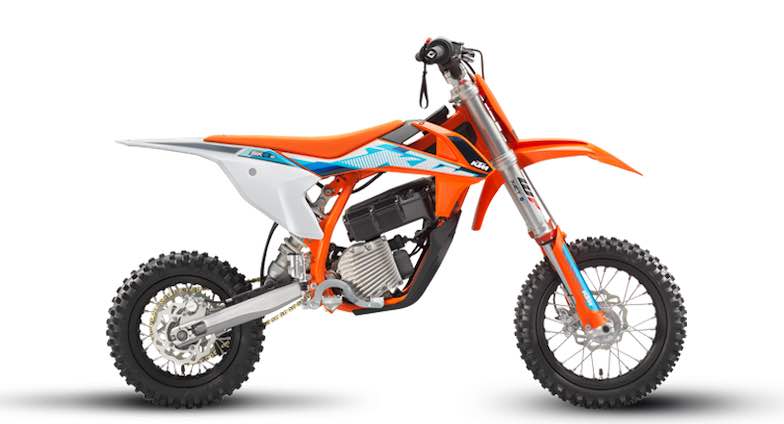
| Husqvarna EE 5 / KTM SX-E 5 / GasGas MC-E 5 | Electric, 6 ride modes | 26.2″ (66.5 cm), adjusts to 24.2″ (61.5 cm) | 89 lb (40.5 kg) | $5,199–5,884 | Racing, experienced kids |
| KTM 50 SX | 49cc 2-stroke | 26.8″ (68.1 cm) | 91 lb (41.5 kg) | $4,699 | Motocross, experienced kids |
| Husqvarna TC 50 | 49cc 2-stroke | 26.2″ (66.5 cm) | 91 lb (41.5 kg) | $4,799 | Motocross, experienced kids |
The Yamaha TT-R50E and Honda CRF50F are the two I’d shortlist first. Both have a 3-speed automatic gearbox, no clutch, a screw-adjustable throttle limiter and 2.50-10 tires. The Yamaha adds electric start, which saves you restarting it every time the kid falls over. The TT-R50E carries riders up to 55 lb (25 kg) and the CRF50F up to 80 lb (36 kg), so the Honda lasts longer for a heavier kid. The small Hondas are famously reliable and popular used.

The EE 5 / SX-E 5 / MC-E 5 is the bigger brother of the 3 series: more power, a 12″ front wheel, a 907Wh battery and racing-level performance. It’s comparable to a 55cc gas bike. The ride modes tame it, but it’s no first bike. The three brands are the same bike in different colors; GasGas is usually cheapest and Husqvarna most expensive. The KTM 50 SX and Husqvarna TC 50 are race bikes for kids who already ride well and want the track. The SSR SX50-A is the budget way in (more in my SSR guide), and the 50cc dirt bikes page compares 13 models.
Ages 9–10: 110cc automatics
For a first bike at 9 or 10, I’d buy a four-stroke automatic or an electric. Trail bikes have mellow power and soft suspension; motocross bikes are stiffer and more aggressive. Start on trail.
| Model | Type | Seat height | Weight | Price |
|---|---|---|---|---|
| Yamaha TT-R110E | 110cc 4-stroke, 4-speed auto clutch, electric start, about 7 hp | 26.4″ (67 cm) | 159 lb (72 kg) | $2,300–2,600 |
| Honda CRF110F | 109cc 4-stroke, auto clutch, electric start | 26.3″ (66.8 cm) | 169 lb (77 kg) | $2,499–2,800 |
| X-PRO X28 | 100cc 4-stroke, kick start, hydraulic brakes | Not listed | 154 lb (70 kg) | $599 |
| Trailmaster TM15 | 100cc 4-stroke, hydraulic disc brakes | Not listed | 125 lb (57 kg) | About $950 |
The TT-R110E is my first choice: clutch-less, electric start, adjustable suspension and a low seat. Used ones with low hours are easy to find. The CRF110F is the Honda equivalent: auto clutch, push-button start, adjustable suspension and a low seat. The X-PRO and Trailmaster are budget bikes that reach about 45 mph; for those, check the seat height on the actual bike before you buy.

Electric at 9–10: the Kuberg Cross Hero ($2,045, 3.0 kW, 17 mph, 73 lb / 33 kg, 20.5″ / 52 cm seat or 59 cm with the seat option, about 2 hours per charge, 6-hour charge) is the affordable pick. The Oset 24.0 Racing ($4,399, 26.4″ / 67 cm seat, 103 lb / 47 kg, about 2 hours of riding) is a trials bike that fits kids, teens and adult trials riders. Oset was bought by Triumph in June 2022.
Motocross, advanced and tall kids only: the KTM 85 SX (84cc liquid-cooled two-stroke, 34.3″ / 87 cm seat, 17/14″ wheels, $6,199) and the Kawasaki KX112 (112cc liquid-cooled two-stroke, about 25 hp and 70 mph, six speeds, Showa suspension, 34.3″ seat, 19/16″ wheels, about $5,399). Both have a manual clutch and serious power. More in my 100cc dirt bikes guide.
Ages 11–12: 110–125cc and full-size electrics
At about 4’8″ (144 cm), an average 11-year-old fits a 26–31″ (66–79 cm) seat. That usually means a 110–125cc four-stroke, a mid-size electric, or an 85cc for a kid who races.
- Kawasaki KLX110R: 112cc air-cooled four-stroke, four-speed with automatic clutch, 26.8″ (68 cm) seat, 2.50-14/3.00-12 tires. $2,899. My first pick for a beginner 11-year-old.
- Honda CRF125F: 125cc four-stroke, manual clutch, 29.1″ (74 cm) seat. $3,200–3,600. The bike to grow into and to learn the clutch on.
- Yamaha TT-R110E: still a good fit for a smaller or newer 11-year-old (see above).
- Oset 24.0 Racing: suspension tailored for riders up to 198 lb (90 kg), adjustable power, so it lasts into the teens.
- Sur-Ron X: 3 kW (6 kW peak), 20–60 miles per charge, 33–34″ (84–88 cm) seat, $4,400. Only for tall, skilled kids.
- Kuberg Freerider: 8, 12 or 14 kW versions, several tire sizes, 33.3″ (84.5 cm) seat, about 2 hours per charge, $3,999. Also for tall kids.

New bikes for this age cost $2,000–4,000; higher-end models go past $4,000. Used bikes run $1,000–3,000. If the question is “fast dirt bikes for 11-year-olds”, the answer is a KTM 85 SX or KX112, and only once the kid has mastered the clutch and brakes on something slower.
Electric or gas?
| Electric | Gas | |
|---|---|---|
| Learning | Easier: no clutch, adjustable power modes | Teaches the clutch and real bike controls |
| Noise | Nearly silent | Loud; can be an issue near neighbors |
| Maintenance | Very little; no gas or oil | Regular oil, air filter and chain work |
| Ride time | About 30 minutes to 2 hours, then hours to charge | Refuel and keep riding |
| Starting | Turn it on | Hard for small kids; electric start helps |
Most kids ride electric until about 7. If the kid gets serious, switch to gas so they learn the clutch. Four-strokes are smoother, easier to start and more reliable. Small two-strokes are powerful, can scare kids, need more maintenance (piston swaps, mixing oil into the gas) and are hard for a 7-year-old to kick start. For more on battery bikes, see my electric dirt bikes guide, and for clutch-less gas bikes, my automatic dirt bikes list.
What else to look for
- Throttle limiter (governor). A screw that stops the throttle from opening all the way. Learners lock their wrist open when the bike pulls, which ends in a fast crash. Open it up as their braking improves. Higher-end electrics do the same with power modes.
- Electric start. Saves you restarting the bike every time it stalls or falls over. Common on small four-strokes, rare on small two-strokes.
- Kill switch and good brakes. Non-negotiable.
- A major brand. Yamaha, Honda, Kawasaki, KTM, Husqvarna, GasGas, Oset and Stacyc handle better, break less and resell better than cheap bikes.
- Buy used. Kids outgrow bikes fast, and some lose interest. A used major-brand bike costs less and sells again easily.
- Gear. A properly fitted helmet, goggles, gloves, boots, chest protector, knee and elbow pads, and long sleeves and pants. See my essential dirt bike gear list.
Training wheels on a kids’ dirt bike
Few dirt bikes come with training wheels from the factory, but most small kids’ bikes take aftermarket ones. They suit kids around 3 to 6 who are struggling with balance, so they can learn steering, braking and throttle first. They bolt to the frame or rear axle and come off quickly once the kid can balance and control the bike alone.
- Rear-mounted: the most common. Easy to fit and remove, and sprung so the bike can lean on uneven ground.
- Mid/center-mounted: more rigid and stable, good for a nervous kid.
- Adjustable mid/center-mounted: the most versatile, with suspension plus adjustable height and angle.
The usual gas bikes for training wheels are the Yamaha PW50 (49cc two-stroke, automatic), Honda CRF50F (49cc four-stroke, 3-speed automatic, throttle limiter) and Suzuki DR-Z50 (49cc four-stroke, automatic, throttle limiter). Model-specific kits on Amazon: adjustable training wheels for the Yamaha PW50, Honda CRF50 / XR50 / Z50R and Suzuki JR50, plus universal kits.

The alternative is to skip them: an electric balance bike or kick bike builds balance first and is cheaper than a gas bike with training wheels. For a 3-year-old, that’s the route I’d take.
My pick
Stacyc 12eDrive
The easiest first bike for 3–5-year-olds: 13″ seat, three speed modes, quick-change battery.
Budget pick
Adjustable training wheels for the Yamaha PW50
Height-adjustable wheels that come off as soon as the kid can balance.
Beginner setup
Once the bike fits, the beginner path covers sizing, setup and the first rides step by step.
FAQ
What size dirt bike is best for a 7-year-old beginner?
A seat height of about 20–24″ (51–61 cm), checked so the balls of both feet touch the ground. For a beginner that means a Yamaha TT-R50E, Honda CRF50F or an Oset 16.0 Racing, all automatics with no clutch.
What is a good dirt bike for an 8- or 9-year-old?
For an 8-year-old (about 4’2″ / 128 cm), a 50–65cc bike with an 18–26″ seat: the Yamaha PW50 or Honda CRF50F to start, the KTM 50 SX or Husqvarna TC 50 for experienced kids. A 9-year-old who’s grown into a 26″ seat fits a gas Yamaha TT-R110E or Honda CRF110F.
What is the best dirt bike for a 10-year-old?
For a beginner, the Yamaha TT-R110E: automatic clutch, electric start and a 26.4″ (67 cm) seat that fits the average 4’6″ (139 cm) 10-year-old. The Honda CRF110F is an equal alternative; the KTM 85 SX and Kawasaki KX112 are for advanced, tall kids only.
What dirt bike suits an 11- or 12-year-old?
A 26–31″ (66–79 cm) seat: the Kawasaki KLX110R for beginners or the Honda CRF125F to learn the clutch. For a fast bike, the KTM 85 SX or KX112, but only after the kid has mastered a slower one. Taller 12-year-olds can use the teen picks.
Can you get a gas dirt bike with training wheels?
Rarely from the factory, but aftermarket training wheels fit most small gas bikes, including the Yamaha PW50, Honda CRF50F and Suzuki DR-Z50. They suit kids about 3–6 and come off quickly once the kid can balance.
