
 By
The short answer
Set the bars so you can ride standing with a slight bend in your elbows and without hunching. Start with the bar position in the clamps (in line with the forks seen from the side), then rotate the bars, then fine-tune lever and grip position. Getting this right reduces arm fatigue and arm pump. Only buy new bars (width, height, rise and sweep) once the stock ones are set up properly.
This post contains affiliate links. As an Amazon Associate I earn from qualifying purchases, at no extra cost to you.
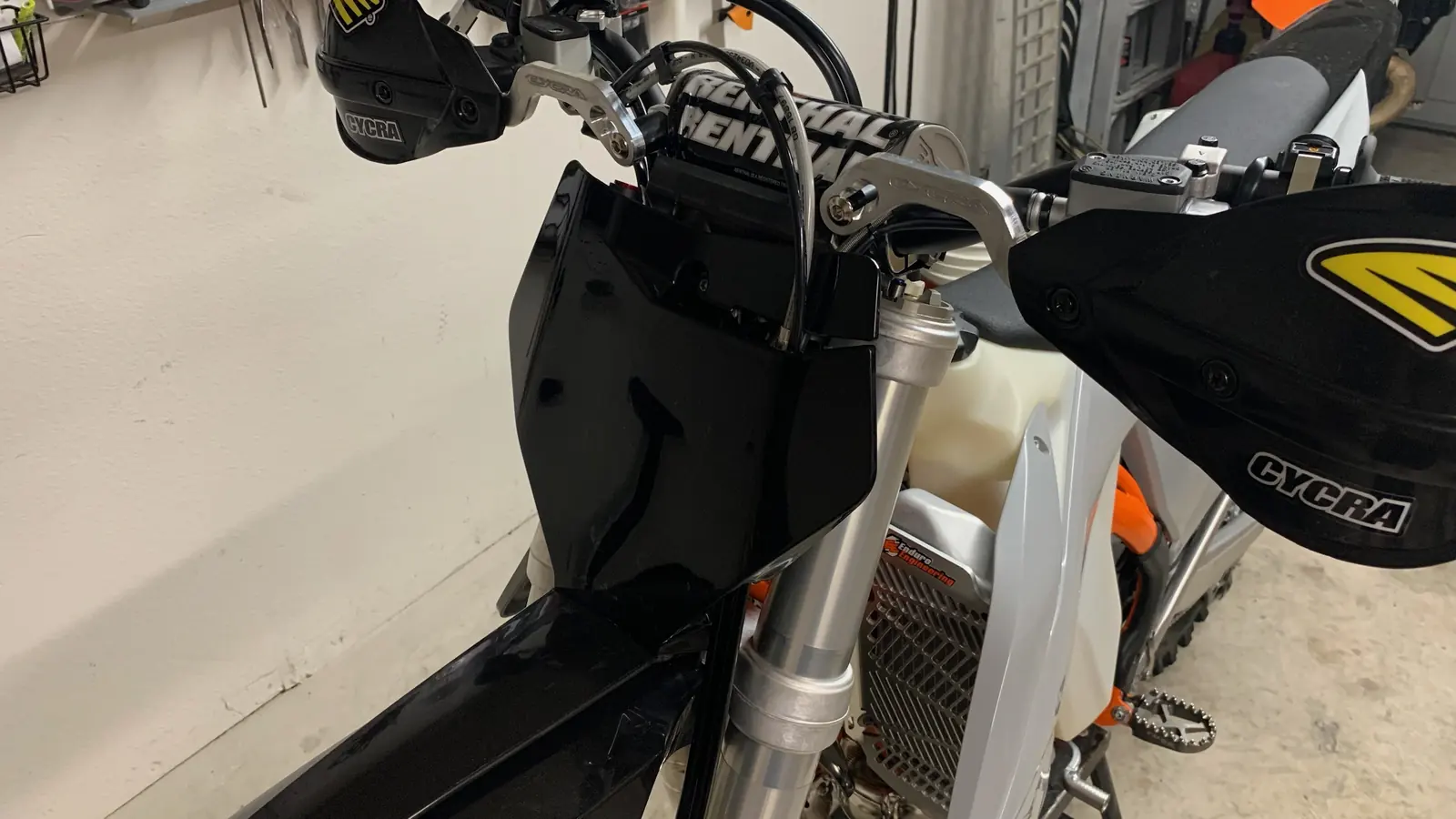
The handlebars are the first thing you grab when you head out on the trail and the last thing you let go of back at camp. Set them wrong and you get sore wrists, a stiff neck, arm pump and, over time, carpal tunnel symptoms.
Bar setup is the single biggest factor in your riding ergonomics, and most of it costs nothing. I start from the factory setup on my KTM 300s and work through three adjustments in order: position, rotation, then levers and grips. Below are the steps, the numbers I use as starting points, and when new bars or risers are worth buying.
Handlebar measurements that matter

Dirt bike handlebars have six measurements. Only four (width, height, rise and sweep) describe the real shape of the bar and decide whether it fits you.
| Measurement | What it is | Typical number / note |
|---|---|---|
| Width | End to end across the bar | About 31.5″ stock |
| Height | Clamp area to the top of the bar end | Changed by moving or rotating the bar |
| Rise | Clamp area to the first steep bend | Add risers to raise it |
| Clamp area | Center section held by the clamps | 7/8″ or 1 1/8″ |
| Control length | Straight ends where grips, levers and switches mount | Must fit all your controls and handguards |
| Sweep (pullback) | How far the ends bend back, seen from the side as an “L” | Changes wrist angle |
Most bars are aluminum: light, rust-free and able to take a crash without bending right away. They come in two sizes. Standard 7/8″ bars have a cross brace in the middle. 1 1/8″ bars (fat bars or tapered bars) have a thicker center and no brace. I recommend 1 1/8″ bars for trail riding because they are stronger and have more flex.
What is the correct dirt bike handlebar position?

With the bike on a stand and seen from the side, the handlebar centerline should follow the line of the forks: not too far forward, not too far back. That is the position I prefer and the one I recommend as the starting point for trail riding. It works the same for motocross handlebar position; only the fine-tuning differs.
From there, your height, arm length and riding style decide the final spot. Lower bars let you muscle the bike more, but bar height still has to match your height. If you can’t hold a comfortable standing position with your elbows up, move the bars.
How to set up dirt bike handlebars in 3 steps
Do these in order. Each step changes how the next one feels, so don’t touch the levers until position and rotation are done.
Step 1: Set the bar position in the triple clamp

- Put the bike on a stand and look at it from the side.
- Set the bar to the center position. Most bikes have four positions in the top clamp, from forward to back. Center is usually the first threaded hole with the clamp offset in its normal orientation (not turned 180 degrees).
- Adjust for your height using the table below.
- If you’re tall and still reaching down, add slightly higher risers or switch to a bar with more rise.
| Rider height | Bar position |
|---|---|
| Under 5’8″ (173 cm) | One notch back (closer to you) from center |
| 5’8″ to 6’2″ | Center, in line with the forks |
| Over 6’2″, or long arms | One notch forward from center; consider risers |
Step 2: Adjust handlebar rotation

- Find the printed chart in the middle of the bar. You may need to lift the bar pad to see it. It shows the center line and incremental marks for rotating forward or back.
- Line the bar up at the neutral (center) mark.
- Rotate forward for more room and a more aggressive turn-in. Rotate back for more stability.
- Check the bar ends. Rotation raises or lowers the grips and changes the grip angle, which moves pressure around your palm. Grips set too high or too low cause arm pump and carpal tunnel symptoms.
- If the grips end up far from level, move the bar forward a notch and rotate it back to bring the grip area closer to level.
Step 3: Fine-tune levers and grips

Badly set controls are where I see new riders struggle most.
- Center the grips and make sure they don’t move at all.
- Angle the clutch and front brake levers slightly down: one finger thickness below level with the bar is a good start.
- Ride, then adjust. My brake and clutch lever positioning guide covers the full process in about 15 minutes.
Other adjustments: rise, width, forks and handguards

Trail and motocross setups differ. Motocross bars often have a different sweep and flex than what works on single track, and the reverse is true too.
Rise and risers
Most riders need between 0 and 2″ of extra rise, depending on the bike and your height. Bars that are too low make you slouch when standing, and you end up sitting more than you should. I recommend a kit of swappable risers so you can test the rise in steps. Risers change handling a little and can reduce front-end grip in corners, but the comfort gain is worth it: you’ll stand more and sit less. Match the riser to your bar size, 7/8″ or 1 1/8″.
Handlebar width
Wide bars give more leverage but hit trees, and in tight woods they can trap you between trunks or throw you off. For trail riding, cut about 1/2″ off each end, which takes a 31.5″ bar to 30.5″, the overall width I also recommend for racing. Wrap-around handguards add about another 1/2″ to total width. Before cutting, check that all your controls still fit; you may need a different clutch-side grip.
Fork height and rake
Sliding the forks up or down in the triple clamp changes bar height slightly, but mainly it changes rake. Steeper forks make the bike turn quicker and feel twitchier at speed. Forks set lower in the clamps make the bike harder to turn and more stable at speed. Even a few millimeters makes a noticeable difference. See how to adjust dirt bike fork height; it takes about 15 minutes.
Handguards
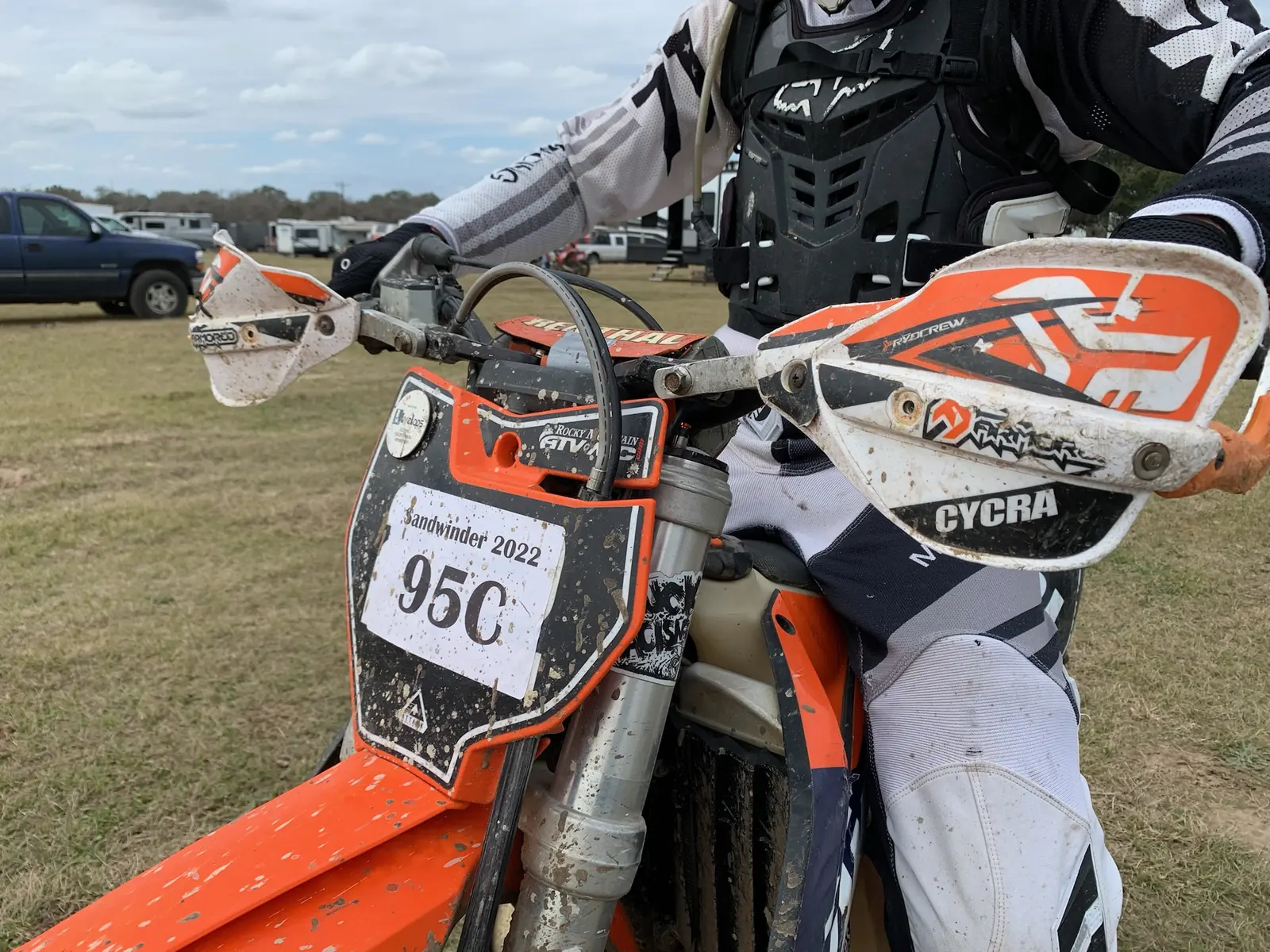
On single track you get hit by branches, trees and roost. Set the handguards low enough to cover both levers and hands. If they sit too high, your wrists can slide under them when you land or hit something. This matters most with metal-backed guards.
When to buy new handlebars
Stock bikes are set up for riders about 5’8″ to 6’2″ tall, depending on make and model. If you’ve done the three steps and still reach too far, sit too low or hunch, buy bars that fit your height.
- 5’6″ to 5’9″: try a low bend, rotated slightly back toward you.
- Over 6′: try a taller bend, rotated or moved slightly forward.
- Clamp size: match your clamps, 7/8″ or 1 1/8″.
- Control length: leave room for handguards, switches and levers.
- Rise and bend: these decide comfort and are hard to judge from a spec sheet. If unsure, stay with the same bend type your bike came with.
For single track and enduro, my picks are 1 1/8″ bars from Renthal and ProTaper. Renthal has a wide range of low and high bends and a handlebar size calculator on its site. ProTaper is the other maker I trust for quality off-road bars. You can also browse handlebars on Amazon or find risers for your model.
What I use
Renthal 1 1/8″ Fat Bar
My first pick for trail and enduro: no cross brace, more flex, and a wide choice of bends.
What I use
ProTaper 1 1/8″ Handlebars
The other quality 1 1/8″ bar I recommend for single track.
What I use
Renthal 1 1/8″ Fat Bar, RC High Bend
A taller bend for riders over 6′ who still reach down after moving the bars forward.
Read next: brake and clutch lever positioning, dirt bike fork height and single track tips for beginners.
Beginner setup
Handlebar position is one of the free fixes in my beginner setup path, alongside the other steps that make a stock bike fit you.
FAQ
What is the correct dirt bike handlebar position?
Seen from the side with the bike on a stand, the bars should line up with the forks, in the center of the four clamp positions. Riders under 5’8″ move them one notch back; riders over 6’2″ move them one notch forward.
What is a typical dirt bike handlebar height from the ground?
About 50″ from the ground to the top of the bars, with the suspension unweighted and the bars in the neutral position.
What is the best dirt bike handlebar width?
Stock bars are about 31.5″ wide, which suits motocross and open terrain. For trail riding and single track I recommend cutting 1/2″ off each end, to about 30.5″.
How do you measure dirt bike handlebars?
Use a tape measure for width, height, rise, clamp area, control length and sweep, then compare against the maker’s charts. Renthal’s handlebar size calculator lists the dimensions of its bends.
What are the best dirt bike handlebars for trail riding?
A 1 1/8″ fat bar from Renthal or ProTaper, in the bend that fits your height. Standard bends suit riders about 5’7″ to 6’2″; go lower or taller outside that range.
