
 By
The short answer
Put the bike on a stand, loosen the top and bottom triple clamp bolts, twist each fork leg and slide it up or down to the ring you want, then torque the bolts to spec. Forks higher in the clamps (more rings showing) make the bike turn quicker; forks flush with the top clamp make it more stable at speed. Start at the middle ring: on my KTM 300 XC-W’s WP Xplor forks that’s ring two of three. The job takes about 30 minutes.
This post contains affiliate links. As an Amazon Associate I earn from qualifying purchases, at no extra cost to you.
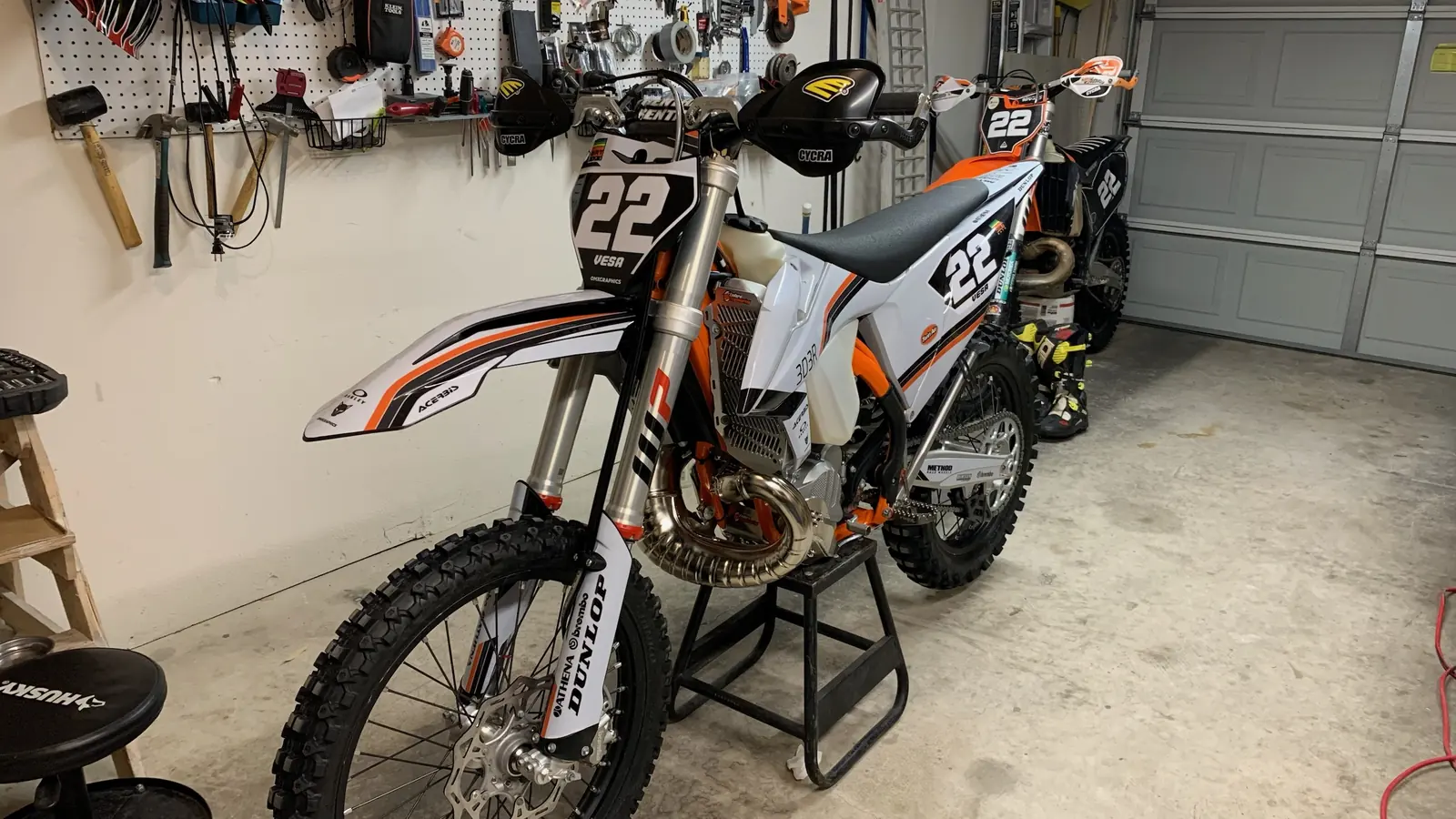
Fork height is the free adjustment most riders never touch. Factory bikes ship with the forks in the middle position, and most owners leave them there. I think everyone should test it, because one ring changes how the bike turns and how calm it feels at speed.
This is how I set fork height on my KTM 300s, what each setting does, and which one to pick for tight single track versus fast, open trail.

What fork height changes
Sliding the forks up or down in the triple clamps changes three things at once: rake angle, trail and front-end height. Together they decide how the bike turns and how stable it is at speed. It’s always a trade-off.
- Forks raised in the clamps (more rings showing above the top clamp): the front drops, rake gets steeper and trail gets shorter. The bike turns easier but gets twitchier at speed.
- Forks lowered / flush: the front rises, rake gets slacker and trail gets longer. The bike is more stable at speed but slower to turn.

Think of a long chopper next to a street bike: the chopper’s slack rake and long trail make it stable but slow to turn. Wikipedia covers motorcycle geometry in detail if you want the theory.
Most factory forks have three to five rings at the top of the tube, about 1 mm apart, so you can set both legs to the same height. “Forks high in the clamp” means more rings are visible above the top clamp; in other words, the triple clamp slides down the fork tubes.
Which fork height to run

| Riding | Fork height | Why |
|---|---|---|
| Tight single track, 2nd–3rd gear | Higher in the clamps: third ring from the top | Quicker turning |
| General trail riding | Middle ring (factory setting); ring two of three on my XC-W | Good all-round balance |
| Desert, fast open tracks | First ring or flush with the top clamp | High-speed stability |
| Mixed slow and fast sections | Compromise; test with your other settings | Find the sweet spot |

You aren’t limited to the rings. I regularly run flush forks (the tube level with the top clamp), and sometimes drop the triple clamp 2–3 mm below the lowest ring. Keep safety in mind and go in small steps.
How to adjust dirt bike fork height, step by step
Tools: the wrench for your clamp bolts and a torque wrench. You can snug most bolts close enough by hand, but over-tightened triple clamp bolts can damage the forks and make them stick.
1. Lift the front wheel

Put the bike on a stand. Place a wrench, a piece of wood or similar under the front of the skid plate so the front wheel is off the ground. If the bike is dirty or you’re trailside, clean the top of the fork tubes and the clamps first; clean tubes slide much easier.
2. Loosen the top clamp bolts

Loosen the top clamp pinch bolts on both legs until they are fully loose. They don’t need to come out. Leave the axle clamp bolts at the bottom of the forks alone.
3. Loosen the bottom clamp bolts

Loosen the bottom triple clamp bolts on both sides. The forks won’t slide out, even with the front wheel installed. A crack or click as the bolts let go is normal and means there was tension or misalignment in the forks; align the forks as you tighten back up.
4. Twist and slide each fork leg

- Grab one fork leg and rotate it. Turning it toward the opening in the clamps makes it move much easier.
- While rotating, push the leg up or down to the ring you want. Move in small steps, starting from the factory (middle) ring.
- Turn the fork back so it faces forward, with the air bleeder screw pointing forward.
- Repeat on the other leg, then check both legs show the same ring and both face forward.
5. Torque the clamp bolts

- Look up the torque specs in your owner’s manual. The top and bottom clamps usually have different specs, and the bottom bolts are usually lower.
- Torque the top bolts on both legs, alternating between the two bolts on each side so the clamp doesn’t bend.
- Torque the bottom bolts to their spec.
Over-tightening adds friction inside the fork, can bend the fork tube, and slows or binds the moving parts inside. Use a torque wrench here every time.
Test ride and fine-tune
- Take the bike off the stand. Hold the front brake and push the bars down a few times. Listen for cracking and feel for binding. If the forks stick, realign them.
- Ride a short loop that matches the terrain you’re tuning for.
- Change one ring at a time. One ring makes a big difference.
- Write down the setting with your suspension clicker notes.
Once you’ve done it, the job takes about 15 minutes, so it belongs on the prep list for every riding weekend. It also works trailside, which makes it easy to test settings on the day. Fork height is one of my 7 best mods to make a dirt bike turn faster.
What I use
Torque wrench
Triple clamp bolts are where over-tightening causes sticky forks; a torque wrench takes the guessing out.
Read next: dirt bike suspension setup, dirt bike handlebar position and how to align dirt bike forks.
Beginner setup
Fork height is a free 15-minute adjustment, and my beginner hub lists the other setup steps that make a stock bike fit you.
FAQ
How do you adjust fork height on a dirt bike?
Lift the front wheel, loosen the top and bottom triple clamp bolts, rotate each fork leg and slide it to the same ring on both sides, then torque the bolts to the manual’s spec. Plan on about 30 minutes the first time.
What fork height should I run on a KTM?
Start at the factory middle ring; on the KTM 300 XC-W’s WP Xplor fork that’s ring two of three. Go to ring three for tight single track and flush for fast, open riding.
Does raising the forks make a dirt bike turn faster?
Yes. Sliding the forks up through the clamps drops the front, steepens the rake and shortens the trail, so the bike turns quicker but is less stable at high speed.
What do the knob adjusters on top of dirt bike forks do?
They are the compression and rebound clickers, not fork height. Turning them in (clockwise) slows the fork; my suspension setup guide shows how to set them.
